
Airdrops have undergone a significant evolution since their inception in the crypto world. This article delves into various airdrop strategies, highlighting their pros and cons, and examines why the emerging points system might be the superior approach. Additionally, it outlines a blueprint for a successful airdrop strategy.
The Airdrop Evolution: From Free Lunches to Strategic Moves
Remember the early 2020s, when DeFi summer was more than just a season, and the term 'airdrop' became as common in crypto lingo as HODL? Those were the days when protocols, in a bid to reward their early adopters, started showering them with free tokens. It was like waking up to Christmas morning, but instead of snow, your wallet was blanketed with airdropped tokens. The crypto community adapted so quickly to this new meta that it turned into an unwritten rule: no airdrop, no love. Such was the allure of these digital manna that failing to drop or designing a less-than-stellar airdrop could spell a PR disaster (Remember Paraswap?). Why? Because, dear reader, crypto degens have a special place in their heart for airdrops – it's the thrill of earning without the risk, a gamble without the stake.
Airdrop mechanisms
- Retroactive airdrops: Commonly issued at the Token Generation Event (TGE), these airdrops reward early participants. While intended to incentivize early activity, they often attract airdrop farmers, potentially rewarding behaviors that don't align with long-term success.
- Yield farming: This ongoing airdrop strategy helps bootstrap core functionalities, such as liquidity provision or trading. However, incorrect incentives might lead to the wasteful expenditure of the token treasury on a handful of farmers.
- NFTs/other protocols: Airdropping to holders of specific NFT collections or stakers of foundational protocols like Celestia has become a trend. While this strategy might not directly enhance protocol functionality, it can significantly boost marketing. However, protocols must be judicious in their allocations to avoid overspending on what essentially amounts to a one-off marketing campaign.
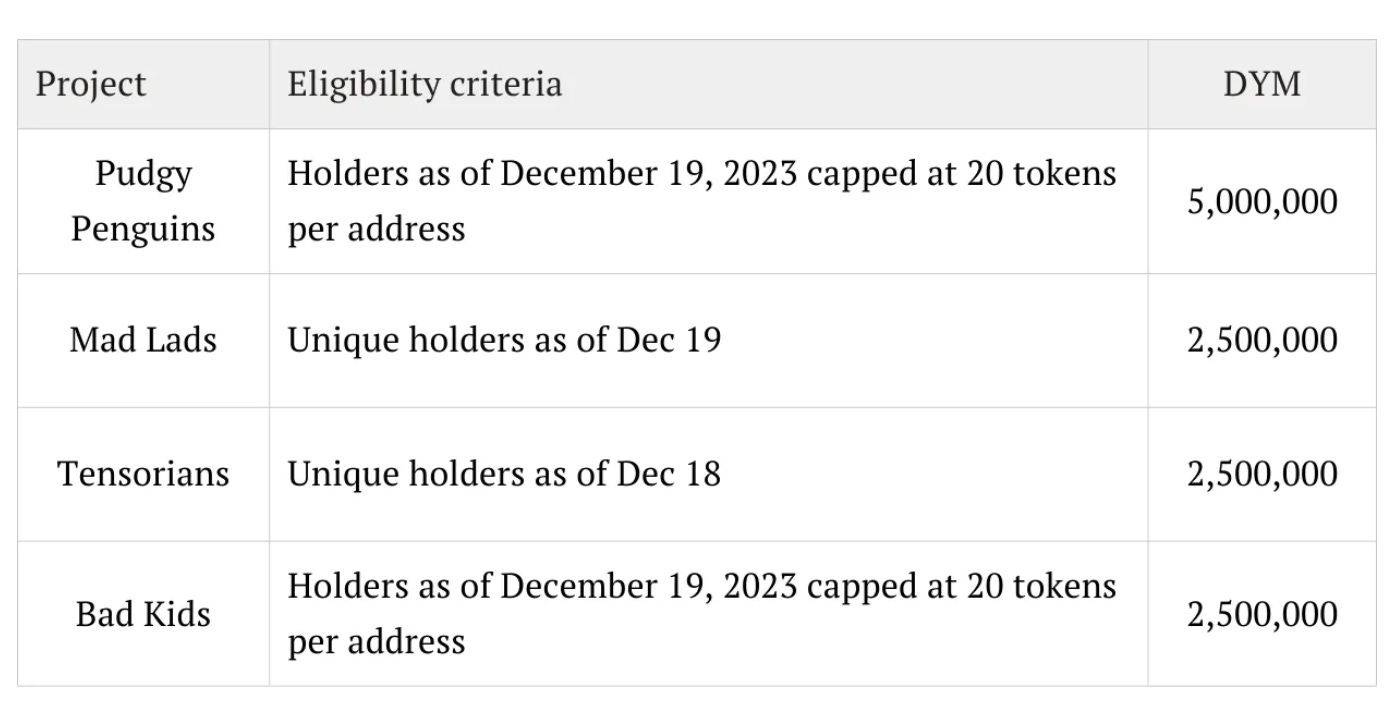 DYM airdrop included four NFT collections.
- Points: The latest meta involves awarding points instead of direct token airdrops, potentially encapsulating the above strategies while offering flexibility and control.
Why Points Might Just Be the Superior Airdrop Model
Before diving into the points system, let me give you a few examples of previous and ongoing airdrop farming attempts:
After the one-time $ARB airdrop, 80% of ARB airdrop recipients stopped being active on Arbitrum.
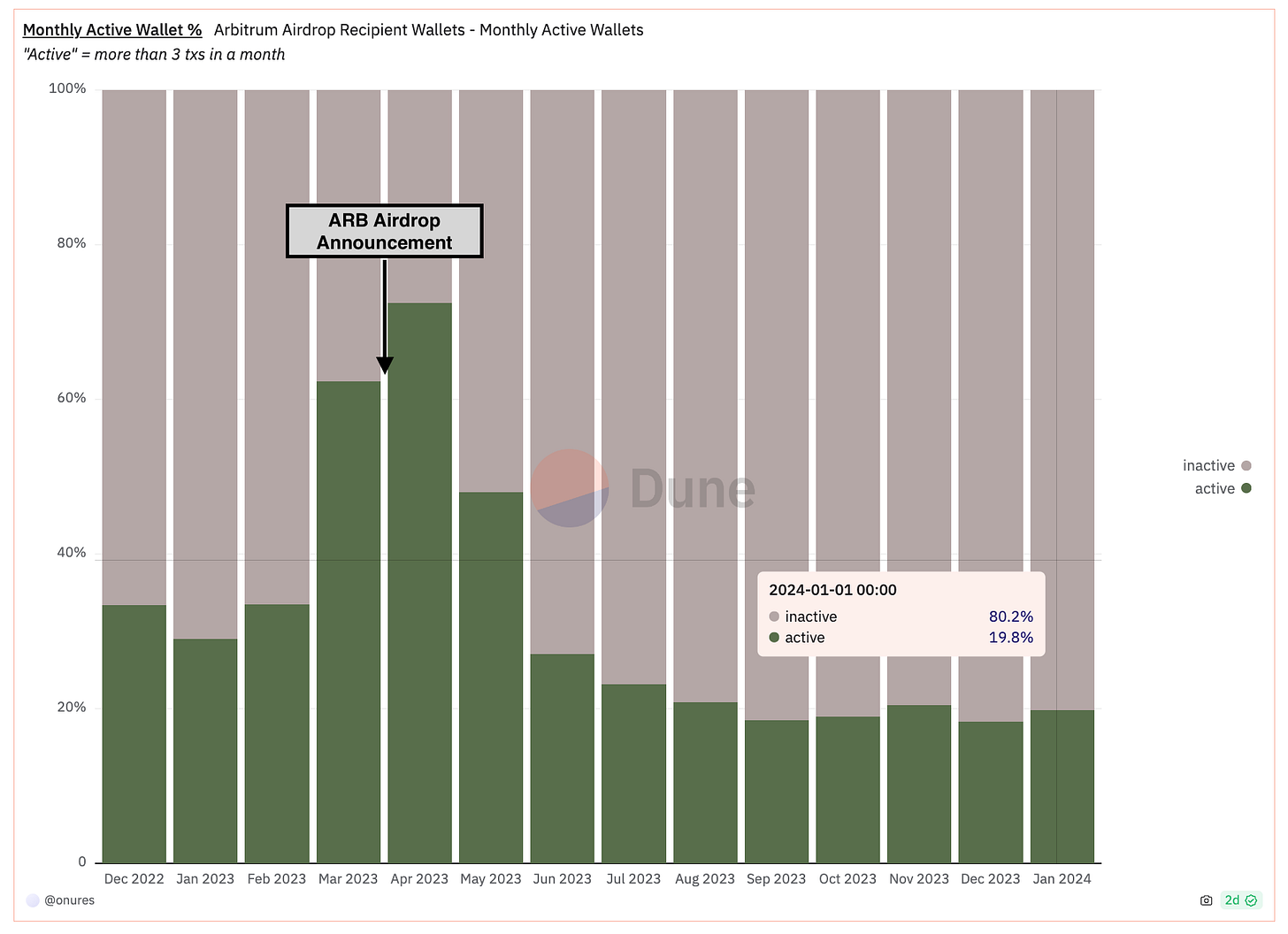
It’s not surprising that airdrop hunters became inactive. When protocol incentives stop, it’s expected that a portion of the user base will churn. But during the time that participation is incentivized, the protocols should incentivize what’s in the best interest of the protocol. Without clear instructions and well-defined success-oriented incentives, airdrop hunters just send a bunch of transactions into the abyss, hoping that what they’re doing will result in an airdrop.
Each L1 and L2 is in competition to attract the best app developers to their platform. Even a single successful app can bring a ton of users, which can kickstart a flywheel:
Successful App → More users & liquidity → More apps → More users & liquidity
Knowing this, Scroll launched its NFT campaign to reward developers building on Scroll with an NFT.
A whopping 1.1 million developers (yes, million with an M) were eligible to get the NFT. To better explain how crazy this number is, Electric Capital estimates that there are 90k active developers in all of crypto.
So there are clearly flaws in the existing airdrop system. To solve those, the points system is reshaping the airdrop landscape by offering several compelling solutions to those problems:
- Engagement & retention: Points, if combined with an ongoing & dynamic structure, create an ongoing incentive structure, ensuring users remain active and engaged beyond the initial excitement of a one-time airdrop.
- Legal flexibility: In a world where regulatory scrutiny is intensifying, points offer a way to reward users without the potential legal complexities associated with tokens.
- Control & adaptability: With points, protocols have more control over their incentive mechanisms, allowing them to adjust and optimize based on user behavior and platform needs.
- Dopamine Appeal: Let's face it, we all love watching numbers go up. Points tap into this fundamental aspect of human psychology, making participation more rewarding and fun.
- Power Dynamics: Most crucially, points shift the balance of power, giving protocols the upper hand in shaping user behavior and curbing exploitative practices.
Looksrare vs. Blur: A Case Study in Airdrop Strategy
One really good example that illustrates how changes in the airdrop strategy can make a huge difference is studying the differences between Blur and Looksrare.
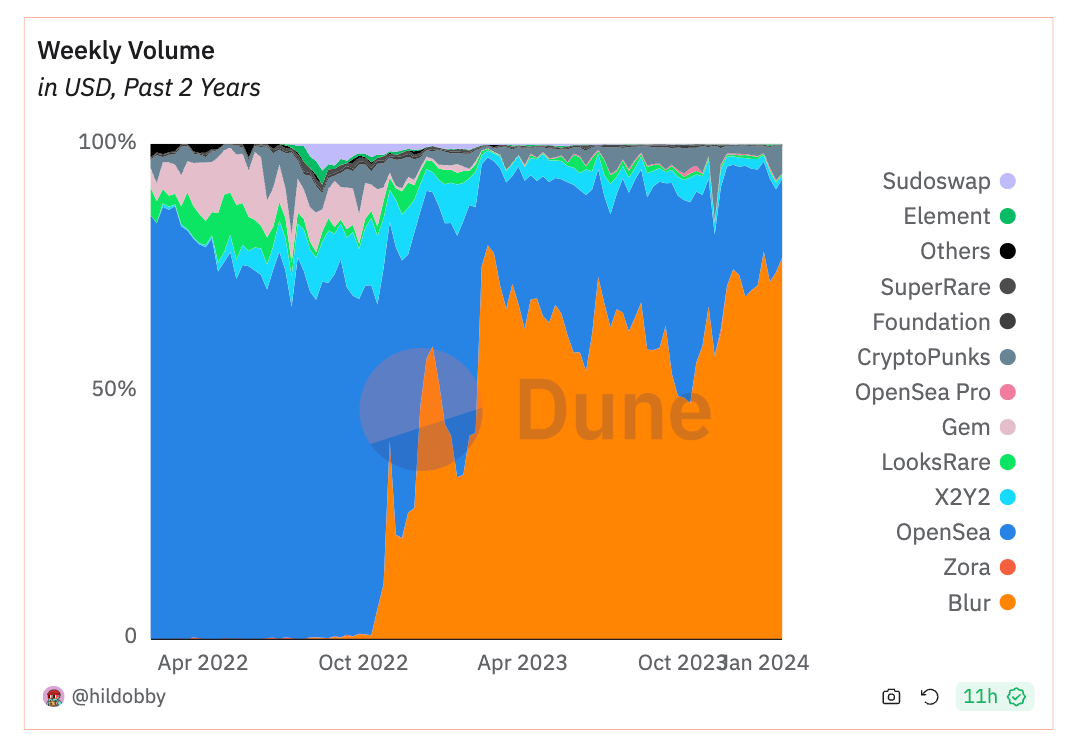 Source: Dune.
- Looksrare This platform's decision to incentivize trading with LOOKS rewards led to unintended consequences. A few whales, attracted by the potential for easy gains, engaged in wash trading of zero-royalty NFTs, securing a large portion of the rewards without contributing to genuine platform growth. This approach failed to attract a broad, organic user base, demonstrating the pitfalls of a misaligned incentive structure.
- Blur In stark contrast, Blur focused on incentivizing liquidity rather than mere transaction volume, employing a points system to reward meaningful participation. This nuanced approach, coupled with the ability to adjust and monitor the points system actively, allowed Blur to mitigate gaming and ensure the incentives served the platform's long-term objectives. The result? Blur emerged as a leading NFT exchange, outpacing competitors in market share and establishing a more sustainable model for growth.
The Rise of Protocol Empowerment & Corruption
Points are more than just a clever incentive mechanism; they represent a fundamental shift in the power dynamics of the crypto ecosystem. By retaining control over the value and distribution of rewards, protocols can more effectively guide user behavior, ensuring actions align with the platform's long-term goals. And here's where it gets tricky: there's no rule saying these points have to turn into tokens. So, after a protocol sees a boost from a points program, it might decide to keep the party going indefinitely, with no real payout for users. Take friend.tech as an example. It was all the rage, with users flocking in to rack up points, only to see the platform turn into a ghost town after users paid over $20 million in fees with little to show for it.
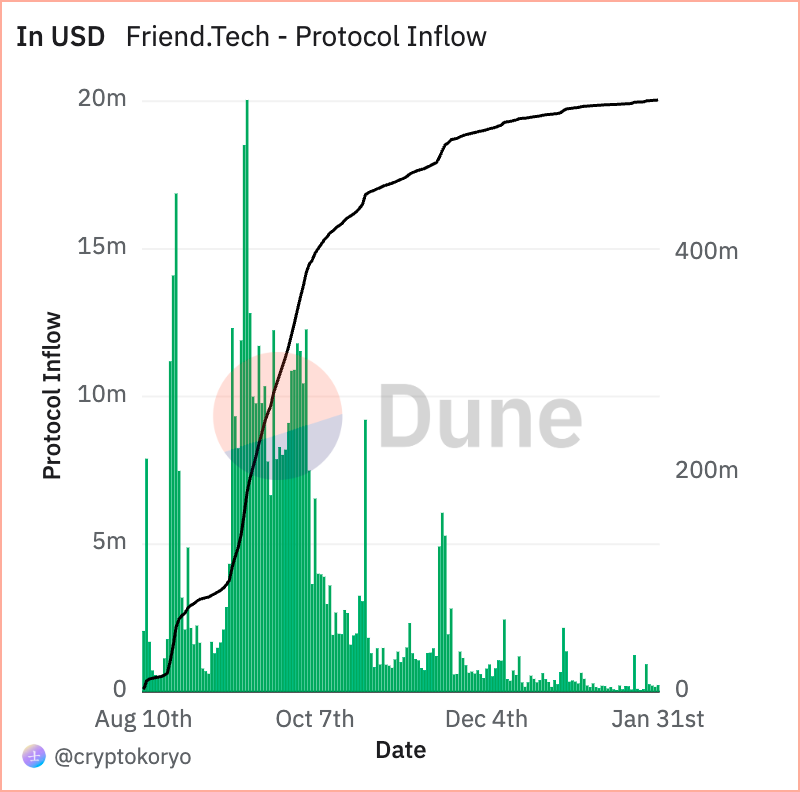 Source: Dune.
Even if points turn into tokens later on, protocols may choose to award a very small portion, which may disappoint most participants. We have seen this playing out mostly in the form of tiered airdrops.
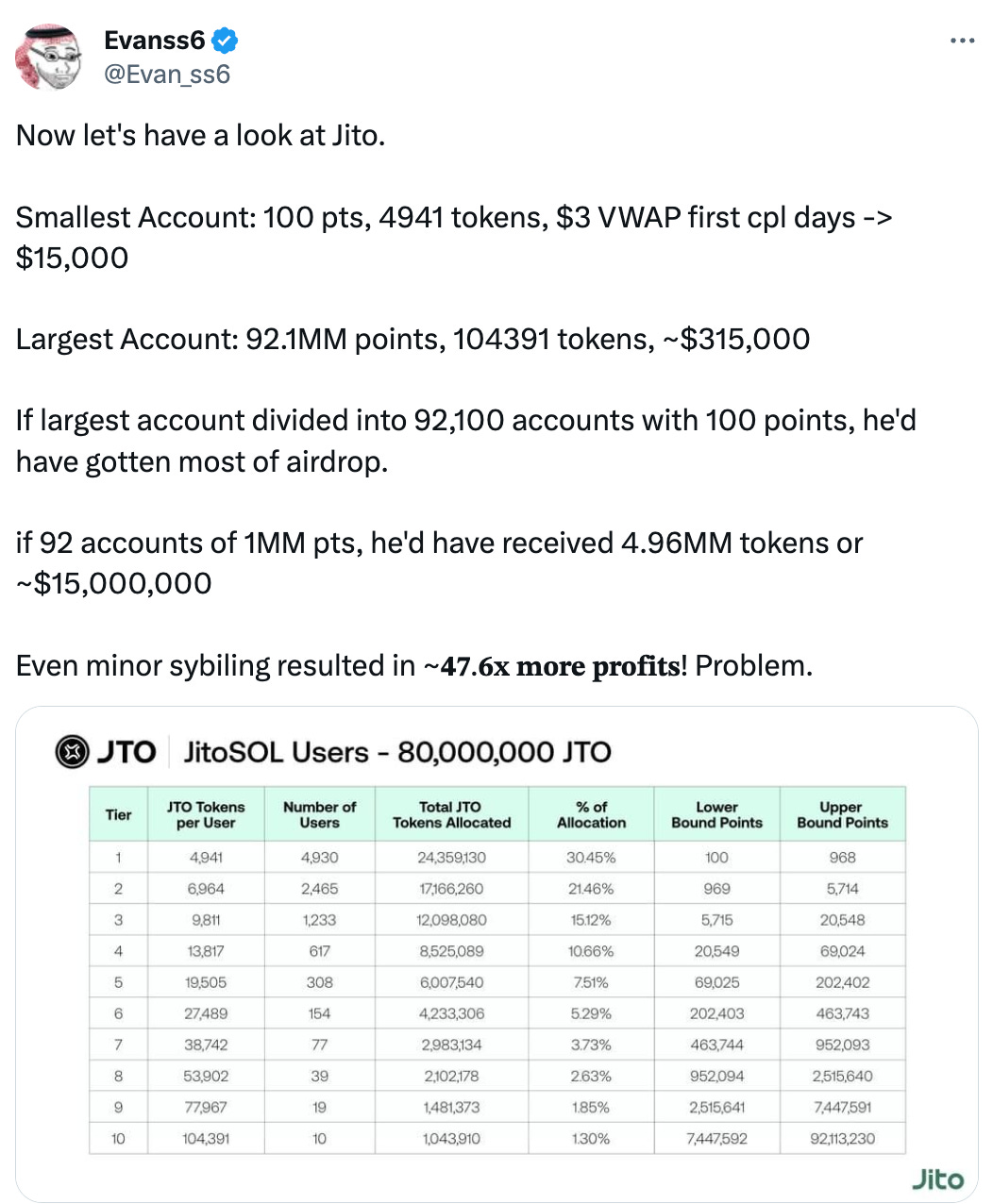 Example of steep tiers distorting incentives (source: tweet).
Looking Ahead: The Sustainable Airdrop Economy
As we venture deeper into this new era, expect points systems to become a mainstay. They're not just a trend but a sustainable model for airdrops, one that balances the thrill of 'free' with strategic engagement and long-term platform loyalty. The airdrop game is evolving, and it's more strategic than ever.
To achieve success in airdrop campaigns, I propose the following fundamental strategies for protocols:
- Establish clearly defined rules that benefit the protocol's long-term success, avoiding incentives for meaningless transactions.
- Implement a points system instead of direct token rewards to allow protocols to control, test, and modify the program based on metrics.
- Multiple and ongoing airdrops (seasons) instead of a single retroactive airdrop.
- Combine retrospective grants, yield farming, and NFT/Other Protocol incentives. All three bring something valuable to the table.
- Allocate the majority of the airdrop supply to users whose actions contribute to the long-term success of the protocol.
- Convert points into tokens within a reasonable timeframe to maintain participant engagement and trust.
- Ensure a linear distribution of tokens relative to points, avoiding tiered conversion that can incentivize undesirable behaviors and raise concerns about fairness.
Big thanks Gokhan, Yoni, Thomas, Gidwell, Marcel, Barkin and Domo for feedback!