
Pendle became popular by letting people trade yield separately from principal—great for “leveraged points farming” or locking in fixed yield. Here’s how it works and a quick way to model one real market (eETH/Eigenlayer points).
Basic principles
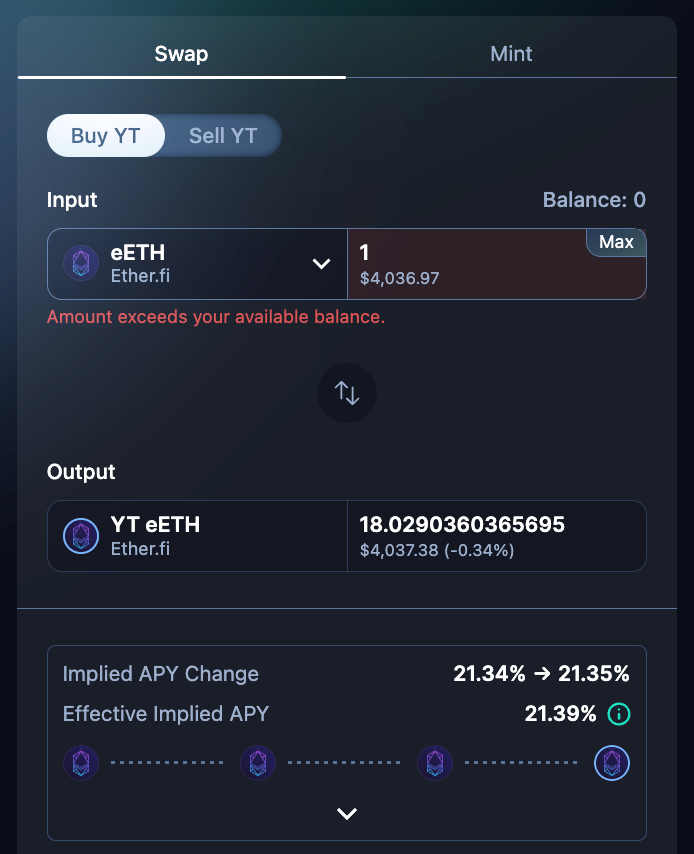
Pendle matches two sides:
- Yield traders (YT) give up principal to gain leveraged exposure to future yield/points.
- Principal traders (PT) give up points/yield to lock in a higher amount of principal now.

Each market has a maturity. By maturity, YT has captured all yield; PT redeems 1:1 for the underlying.
Etherfi / Eigenlayer example
eETH carries three yields: ETH staking, Etherfi points, Eigenlayer points. You can value YT by modelling likely point payouts vs. price paid.
- Example snapshot assumption: 2024-06-01
- Points → tokens linearly
- Eigen TVL grows to ~4.7M ETH
- Consider worst/best FDV and % supply to airdrop.
 Sheet-based modelling for Eigenlayer points. Source: Steven Shi.
In one scenario, 1 ETH of YT could return ~0.9–2.6 ETH equivalent in points before maturity—plus Etherfi points and potential AVS airdrops.
Risks to mind
- Points might never become tokens, or convert non-linearly.
- Snapshot dates, TVL, FDV, and allocation % are uncertain.
- Smart-contract risk across all underlying protocols.
- Leverage amplifies both upside and liquidation risk.
Pendle is powerful but complex—model assumptions, size positions conservatively, and remember points ≠ guaranteed tokens.